
SketchUp Pro Advanced Workflows – with point clouds och Revit-import
SketchUp Pro Advanced Workflows helps teams create better coordination between real-world data, models, and project materials.
Explore the functionsWhy choose SketchUp Pro Advanced Workflows?
Work with point clouds and Revit data

Combine point cloud data and Revit files in a more cohesive SketchUp workflow. SketchUp Pro Advanced Workflows makes it easier to use real-world data and existing project models as a basis for design, coordination, and visualization.
Import Revit models more smoothly

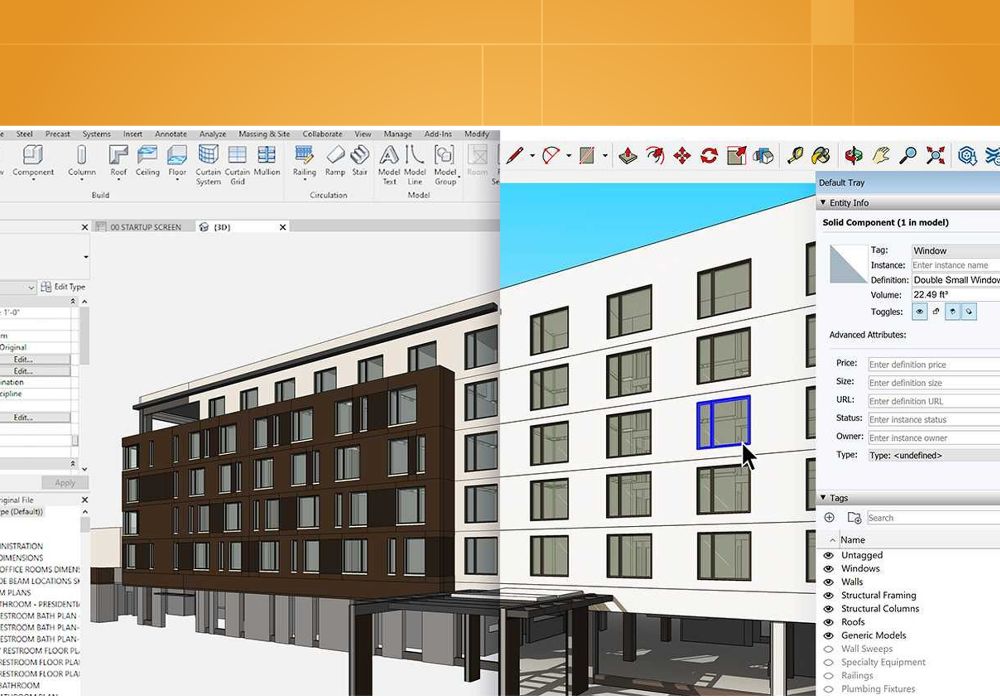
With Revit Importer, you can import Revit models, families, and 3D views into SketchUp. It makes it easier to continue working with existing BIM data and quickly explore design options in a more flexible 3D environment.
Model with real context

Use point clouds to understand the existing conditions and model with better local context. It helps the team make decisions based on the actual conditions and create a clearer basis for design and coordination.
Create better coordination

Gather models, real-world data, and project materials in a visual workflow that more people can understand. SketchUp Pro Advanced Workflows helps teams build shared understanding faster and collaborate more effectively across different tools and disciplines..
Who will benefit from SketchUp Pro Advanced Workflows?
SketchUp Pro Advanced Workflows is among others used by:
- Architects
- Designers
- Construction Teams
- Technical consultants
- VDC- och BIM-teams
For those who want to combine point clouds, Revit models, and 3D modeling into a more cohesive workflow. With SketchUp Pro Advanced Workflows, you can import Revit models, work with point cloud data, and further develop projects in SketchUp. The solution helps teams create better coordination, clearer visualizations, and more efficient workflows between different tools and data sources.
6 Selected Features in SketchUp Pro Advanced Workflows
SketchUp Pro Advanced Workflows is designed for projects where multiple data sources and tools need to work together. Here are some of the possibilities that help you combine Revit data, point clouds, and 3D modeling in a more efficient workflow..
Revit Importer

With the Revit Importer, you can import Revit models, families, and 3D views into SketchUp. It makes it easier to use existing BIM data and continue working on models in a more flexible 3D environment.
Scan Essentials

With Scan Essentials, you can import, view, and model directly on point cloud data in SketchUp. It gives you reality-based context as a foundation for planning, coordination, and further design.
Combine BIM and reality data

Gather Revit files and point clouds in the same workflow to get a clearer picture of both the planned and existing environment. It gives better conditions for design decisions, coordination, and visualization.
Work more efficiently between tools

Reduce the friction between different programs and data sources by bringing Revit and scan data into SketchUp. It makes it easier to keep working visually without having to build up the project base from scratch.
Create better coordination

Visualise and gather different types of project information in a shared 3D context. It helps teams understand the big picture, spot issues earlier, and create better alignment between different disciplines.
Faster way from material to design
Use existing Revit models and point cloud data as a starting point for further design in SketchUp. It makes it easier to quickly test ideas, develop alternatives, and create clear visualizations based on existing project material.
What's the difference between SketchUp Pro Scan and SketchUp Pro Advanced Workflows?
SketchUp Pro Scan is mainly focused on working with point clouds through Scan Essentials. SketchUp Pro Advanced Workflows also includes Scan Essentials, but adds the Revit Importer and more tools for advanced workflows between different data sources and models. So, it's better suited for teams that need to combine point clouds, Revit files, and 3D modeling in the same project flow./p>
Do I need to have Revit installed to import Revit files?
The Revit Importer is used directly in SketchUp for Desktop to import Revit files into SketchUp. So you work with the actual .rvt file in the import process.
The importer transfers things like geometry, materials, textures, building levels, tags, and BIM data into the SketchUp model.
Does SketchUp Pro Advanced Workflows work on Mac?
The advanced features for Revit import and point clouds are Windows-based. The Revit Importer is only available for SketchUp for Desktop on Windows, and Scan Essentials requires 64-bit Windows 10 or Windows 11.
If you're unsure whether your current workstations meet the requirements, NTI Sweden can help go through the technical details.
Can I choose which information from a Revit model gets imported?
Yes. With the Revit Importer, you can choose which 3D view, construction phases, and categories from the Revit model to import into SketchUp.
This makes it possible to limit the amount of information and create a more relevant SketchUp model for the current workflow.
Can I work with both point clouds and Revit models in the same project?
Yes. SketchUp Pro Advanced Workflows includes both Scan Essentials and Revit Importer.
It makes it possible to use point clouds as a reality-based context while importing Revit data into SketchUp for further modeling, visualization, and coordination.
Can I try SketchUp Pro Advanced Workflows before I decide?
Contact us if you'd like to evaluate SketchUp Pro Advanced Workflows. We'll help you review your needs and how features like Revit Importer and Scan Essentials can fit your workflow.
We can also answer questions about licensing options, technical requirements, and how the solution differs from other SketchUp alternatives.
Do you want to try SketchUp Pro Advanced Workflows?
SketchUp Pro Advanced Workflows helps you combine point clouds, Revit backgrounds, and intuitive 3D modeling into a more cohesive workflow – from existing conditions to clear models, visualizations, and project documentation. Fill out the form and we’ll help you get started and answer questions about features, licenses, and how SketchUp Pro Advanced Workflows can fit into your workflows.
Vi kan bland annat hjälpa dig med:
- Information about trial periods and license options
- Advice on point clouds, Revit import, and advanced 3D workflows
- Guidance for coordination, visualization, and project planning using multiple data sources