
The path to future salmon production with digital tools
March 2026With a steady eye on continuously improving the small and large cogs of the value chain, Nordlaks is in full swing expanding and modernising its facility on Børøya in Stokmarknes. When completed, the project will include new features, methods and sophisticated details to significantly increase the welfare of the salmon and employees.
To ensure high quality and efficient collaboration on a complex construction project, Nordlaks has adopted digital tools such as Autodesk Construction Cloud (ACC) and 3D scanning with Matterport.
“By testing new technologies and production methods, we have, since start-up, developed solutions for our own operations that have consistently benefited the aquaculture industry. At the same time, the craftsmanship involved in salmon processing and in the construction of our facilities is equally valuable and important to preserve.
"We have therefore invested significant thought and effort into finding tools that provide the level of detail such a project demands,” says Tomas Tømmerås, Operations Director at Nordlaks Produkter.
Corporate social responsibility on land and at sea
The Nordlaks journey began as early as 1989, when Inge Berg took over his first, very modest fish farm in Vesterålen. At the time, feed was rowed out to the cages and distributed by hand. Today, the company is the second-largest family-owned seafood business in the world.
“When we embarked on the largest expansion of our factory to date, it was only natural to make use of the increasingly sophisticated digital tools that the construction industry had developed over the same period. It is a decision we are very pleased with today. The precision and accessibility of these tools, particularly in planning, communication, broad participation, and effective collaboration, make a significant difference,” says Tømmerås
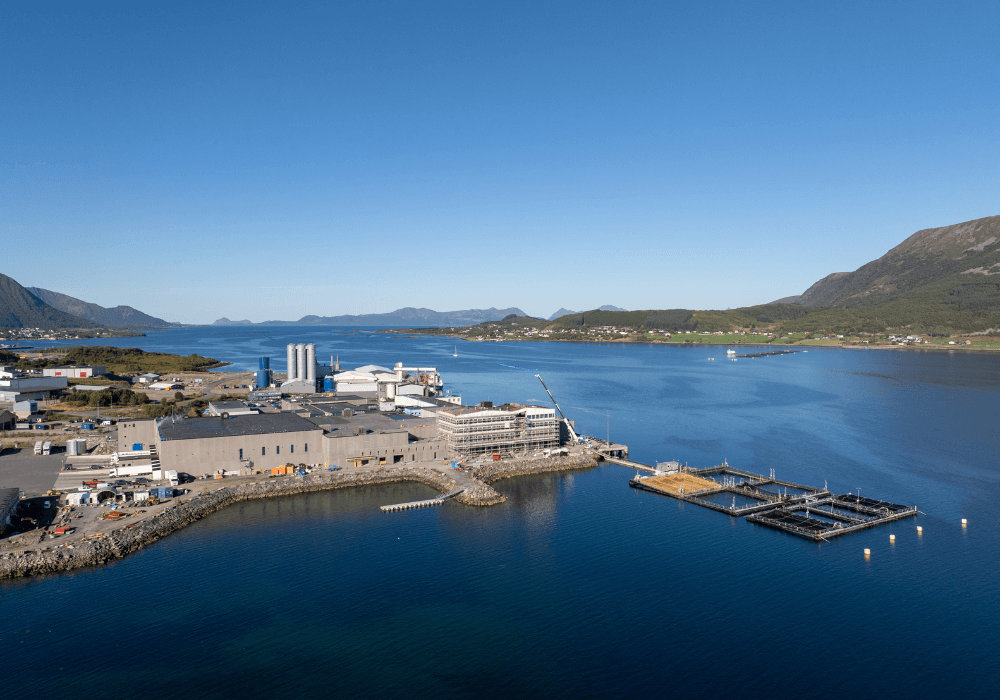
Nordlaks' facility on Børøya
Photo: Nordlaks
Challenging construction projects
The shell buildings are scheduled to be completed in the summer of 2025. Once finished, they will be fitted out with all the equipment required for production. The budget for machinery and production equipment significantly exceeds the cost of the buildings themselves. The facility is expected to open around the turn of 2026/27.
Constructing a factory that is considerably larger than any other building in the town and located so far north, presents logistical challenges. Tømmerås and his team therefore quickly decided to use Autodesk Construction Cloud (ACC), a tool that has played a crucial role in minimising design errors and ensuring the highest possible quality.
“Quality and sustainability must run through everything we do, without exception. Especially in a large, bespoke European project like this. With a wide mix of suppliers and several parallel sub-projects under way, we quickly recognised the need for close and precise collaboration. Everything is happening on a small island in the far north, while most of the equipment and machinery is sourced from Germany. Even a minor ordering error can have major consequences when supply lines stretch over 2,500 kilometres,” says Tømmerås. He adds that the new tools have saved him several hours of work, while significantly reducing the need for travel.
Many needs to be met
The construction project has three stated objectives. An estimated 20,000 new additional square metres will be created to support future food production, including a fillet factory with two new production lines designed to increase the level of further processing and enable new products for a salmon-hungry market. In addition, a new administration building will house the headquarters of the Nordlaks Group, along with meeting rooms and office facilities.
The administration building will also include a new canteen and changing facilities for employees working in the various production departments. A new slaughterhouse, with double the current production capacity, will be built adjacent to the existing facility, which will be repurposed to accommodate support systems.
“It is effectively ‘open-brain surgery’ that we are carrying out. We are building wall to wall, and through the wall, into a fully operational salmon slaughterhouse. In that situation, there is no room for trial and error. Every opening must be exactly where it is supposed to be. That is why we follow a highly structured process in which the model is central to everything we do. We hold digital clash-detection meetings with colleagues on site and with others based abroad. For example, when we are preparing for coordination meetings about pipework in the next room, we begin with the model and use it to explain precisely where and how the work will be carried out. It is all about creating a shared understanding and a common frame of reference,” says Tømmerås.
Digital tools open up many opportunities
This is a large construction site, and the digital tools open up a vast range of possibilities that we would never have had otherwise. Everything becomes accessible and easy to work with. I am no longer tied to my own PC to get the specific views or documents I need at any given time,” says Tømmerås
Precision modelling of the existing
Tømmerås explains that the company has been working with 3D modelling for many years. However, storage formats and software have not always kept pace with developments, and not all models have been updated in a timely manner. Over time, this has resulted in a fragmented and partially outdated model library.
To accelerate construction and model the missing elements of the existing building, Nordlaks has therefore invested in a new 3D scanner from Matterport.
“When we build new facilities, we also need to install equipment and make adjust the existing parts of the factory. For one of our subcontractors, access to a scan was essential in order to model the additional equipment efficiently. With the scan in place, it was quick and straightforward to create a model with the required properties and functionality.
“A fast and reliable way of obtaining an accurate digital representation of what already exists is invaluable. As our ideas begin to take physical shape, it is also extremely useful to use scans for follow-up and virtual inspections across different platforms, software environments, national borders and professional disciplines. In this way, we can clearly document what has actually taken place on the construction site,” says Tømmerås.
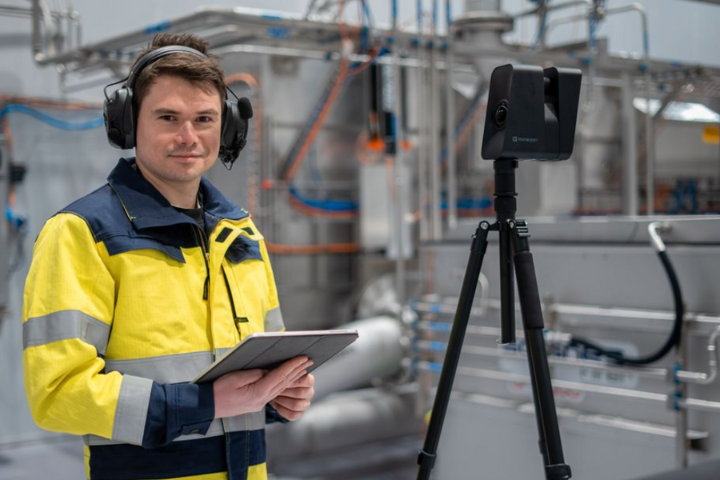
Process engineer Spartak Burkhanshin documents the production environment with Matterport Pro3.
Photo: Northern Salmon
The most important resource
The entire value chain is located north of the Arctic Circle. The natural environment of Northern Norway gives both the products and the group a clear and holistic profile as healthy, clean and fresh. The owners and management are also keenly aware of their responsibility as the region’s most important cornerstone company, employing more than 800 people. As a result, relocating further south has never been considered.
“By involving employees broadly, we create a strong sense of ownership of the finished building. At the same time, a high level of participation leads to well-considered solutions grounded in professional expertise and experience. Digital models and an efficient case-management system make it easy to share complex drawings and proposals, gather feedback, and incorporate valuable input. This, in turn, fosters greater commitment, enthusiasm and a lasting human quality for those who will work here.
“We are our own client and manage the project on our own terms, which allows us to think long term. That is important, because we will be living with what we are building for many years to come. What we have gained from digital tools will therefore be used to their full potential over time. For us, these are not just project tools—they are tools we will use extensively in management, operations and further development well into the future,” concludes Tømmerås.